How far can a CCTV camera see depends on what you need to see. Most cameras can detect movement from 30 to 100 feet away. However, spotting someone at 100 feet is different from clearly identifying their face. Most cameras cannot do both at that distance.
The farther a person is from the camera, the less detail the camera can capture. Installers use four levels, called DORI, to measure how clearly a camera can see something.
The table below gives you an overview, followed by a closer look at what affects camera range:
| DORI level | What you can do | Typical distance |
| Detection | Tell that a person or vehicle is there | 50 to 100+ ft |
| Observation | See what they are doing, what they wear, and how many people there are | 30 to 60 ft |
| Recognition | Know if you have seen this person before | 30 to 50 ft |
| Identification | See a face clearly enough to confirm who it is | 15 to 40 ft |
Learn how far security cameras can see, what affects their range and clarity, how night vision works, and how to choose the right camera placement for better property coverage.
How Far Can a Security Camera See by Camera Type
It varies by camera type, and the answer is different if you are looking for face detail. In the table below, “general monitoring range” is the distance over which you can usefully monitor a scene, not the distance at which you can read a face.
| Camera type | General monitoring range | Best use |
| Wide-angle fixed (about 2.8 mm lens) | 20 to 50 ft | Porches, entries, small yards |
| Varifocal | 50 to 150+ ft | Driveways, gates, side yards |
| 4K fixed | 30 to 100 ft | Wider scenes that still need detail |
| PTZ with optical zoom | 100 to 200+ ft | Large lots, parking areas |
| Thermal | Detection only | Dark perimeters, no face detail |
| Doorbell camera | 15Face-level | Front door, clear night view |
Face-level detail is always going to be less than these ranges. A varifocal camera might be looking down a 150-foot driveway, but it won’t show you a face at the far end.
CCTV Camera Range by DORI: Detection to Identification
Seeing far and seeing clearly are two very different things. DORI measures the second one by counting how many pixels land on each foot of the scene. You need about 8 pixels per foot for Detection, 20 for Observation, 40 for Recognition, and 80 for Identification.
Fewer pixels per foot means a smaller, blurrier subject. That’s why the same camera can detect a person at 100 feet and completely fail to detect one at 25.
Detection and Observation: Parking Lots and Driveways
Take a 1080p resolution driveway camera with a 90-degree lens, and it’ll still show someone in the frame at about 120 feet. It’ll show you how many people there are and what they’re wearing out to about 48 feet.
Those figures come from the DORI pixel count and the lens angle, not any manufacturer’s spec sheet. Treat them as a very conservative guide.
Recognition and Identification: Front Doors and Gates
Place a gate 25 feet from the same wide-angle 1080p camera. The camera can recognize a person from about 24 feet away, but it needs to be within about 12 feet to capture enough detail to clearly identify their face.
So, someone standing at the gate can be visible, but their face may not be clear enough to confirm their identity. That’s why gate and door cameras often use a narrower lens or higher resolution to capture more detail.
Clear facial identification is most important at the front door. People usually walk straight up to the camera when they enter, so this is where you need the clearest view to see who came to your property.
What Changes How Far a Security Camera Can See
Four things determine a camera’s actual range- the lens, the resolution, the light, and where you mount it. Alter any one of those and the figures in the tables above will change.
Lens and Focal Length
A short lens gives you a wide view, but you can’t see the details clearly. A long lens gives you a narrow view, but it can capture detail much farther away. Sensor size makes a difference as well, so the same lens size will give you quite different angles of view on different cameras. Always read the angle for the particular camera you’re looking at, not just the lens size on the box.
Resolution and Pixel Density
Resolution is how many pixels you have to spend across the scene. A person 40 feet from a camera with a 90-degree lens would fill an 80-foot-wide scene.
A 1080p camera spreads 1,920 pixels across those 80 feet, or 24 pixels per foot. That’s sufficient for Observation. A 4K camera will spread 3,840 pixels across those 80 feet (48 pixels per foot), which takes you right up to the Recognition level. Same lens, same spot, just double the pixels.
Night Vision and Lighting
Infrared enables a camera to see in the dark. The glow that reaches far is not the same as detail that reaches far, and the night section below looks at that gap.
Mounting Height, Angle, and Obstructions
Trees, porch posts, bright sunlight, rain, and dirt on the camera lens can reduce how far it can see. Placing a camera behind a window can also cause problems because its infrared light reflects off the glass and creates glare. Before checking the camera’s specifications, make sure nothing is blocking its view.
CCTV Field of View and Coverage Area: Length and Width
Field of view is how wide a scene the camera covers at a given distance. Resolution is how much detail fits in that scene. You can work out how far a camera sees at each DORI level by combining the two.
Here’s the coverage math in two steps.
Step 1. Scene width (ft) = horizontal pixels ÷ pixels per foot you need
Step 2. Distance (ft) = scene width ÷ (2 × tan(field of view ÷ 2))
Worked examples for step 1:
- 4K (3,840 pixels) at Identification (80 pixels per foot): 3,840 ÷ 80 = 48 feet wide
- 1080p (1,920 pixels) at Identification: 1,920 ÷ 80 = 24 feet wide
- 4K at Recognition (40 pixels per foot): 3,840 ÷ 40 = 96 feet wide
It’s just plain old arithmetic on the DORI pixel values, and it’s a quick way of checking a camera against a real spot on your property. A few runs of step 2 for a range of common lenses give the distances below:
| Lens | Field of view | 1080p, Identification | 4K, Identification |
| 2.8 mm | about 100° | about 10 ft | about 20 ft |
| 4 mm | about 80° | about 14 ft | about 29 ft |
| 6 mm | about 50° | about 26 ft | about 51 ft |
| 12 mm | about 27° | about 50 ft | about 100 ft |
These are the best-case figures with good light, face pointed directly at the camera, and a full-resolution image being viewed.
Maker spec sheets will often list a longer DORI than this calculation produces, so always check the spec sheet for the exact camera in question. Use the figure in the table as your conservative figure and the spec sheet figure as your optimistic one.
How Far Can a Security Camera See at Night
Built-in infrared on a typical camera reaches roughly 30 to 100 feet. For example, one Hikvision 4MP turret camera lists 100 feet (30 meters). That number is how far the infrared glow travels, and it says little about how far you can pick out a face.
Face detail at night is considerably shorter than in daylight. One buying guide from a retailer puts the night face detail at 5 to 10 feet shorter than the daytime detail. If you need to identify someone at a door or gate in the dark, plan for a closer camera, a better sensor, or additional lighting.
A few things help stretch usable night range:
- Floodlights in the area you’re monitoring give the camera actual light to work with.
- Color night vision retains more detail than a black-and-white infrared image on cameras that have it.
- Thermal cameras show heat and are therefore very good at detecting a person in total darkness. They won’t show you a face, though.
Can Your Network Reach the Camera? Cable and Bandwidth Limits
Copper Ethernet and PoE cables can carry data and power up to 328 feet (100 meters). This total includes the patch cables at both ends, leaving about 90 meters for the main cable run.
For longer distances, you’ll need a network switch, PoE extender, or fiber cable. A PoE extender can add around 100 meters, depending on the model and setup. Use solid copper cables rather than copper-clad aluminum, which can reduce the distance over which PoE works reliably.
For most homes, cable distance isn’t a major problem. A detached garage 75 feet from the house is well within the limit. Bandwidth should also be considered, as it determines how much data your network can handle at once. 4K cameras send more data than 1080p cameras, so your network switch and recorder must be able to handle the extra load.
For long or difficult cable runs, R&N Technical’s network installation services can help prepare the cabling before installing the cameras.
Surveillance Camera Coverage: How to Plan Your Property
Plan your camera coverage by zone rather than by camera count. Match the camera to the job it has to do- wide angle for porches and entries, varifocal for driveways and gates, and PTZ or long lens for large lots. Then go and check the meeting points.
Before you buy anything, run through this list:
- Mark the areas where you need a face and the areas where you just need to know something has moved.
- Measure the distance from each potential camera position to those zones.
- Check that the adjacent cameras do a bit of overlapping so there’s no gap.
- Look for blind spots created by trees, posts, eaves, and parked vehicles.
- Confirm there’s a cable running from each camera to the recorder or switch.
Camera placement, the wiring, and the network connection all have an effect on each other, and if you fix one thing in the end, it invariably means you’ve to go and fix another. R&N Technical does that planning as one job, and our best security camera installation services will cover the layout, the mounting, the cabling, and the setup.
Can a Security Camera See Through Walls?
No, a standard security camera can only record what is in front of its lens. Thermal cameras cannot see through walls either. They detect heat from surfaces, but walls block FLIR explains heat coming from objects behind them. Glass also reflects infrared radiation instead of letting it pass through, as explained by FLIR.
Can You Point a Security Camera at Your Neighbor?
You can point a security camera at your own property, but avoid recording private areas such as your neighbor’s bedroom or bathroom windows. Accidentally capturing part of the street or a shared driveway is different from deliberately filming someone’s private space.
In Colorado, if you record or photograph someone’s intimate areas without consent in a place where they expect privacy, it is a criminal offense. Audio recording has separate rules, so check these before enabling your camera’s microphone.
If your camera captures an area it shouldn’t, you can:
- Adjust the camera angle.
- Use privacy masking to block part of the view.
- Discuss the issue with your neighbor.
- Check local and HOA rules.
- Contact local authorities if the issue continues.
This is general information, not legal advice. If you have a specific dispute, contact an attorney for help.
How to Tell If a Security Camera Is Watching You
Look for these three things:
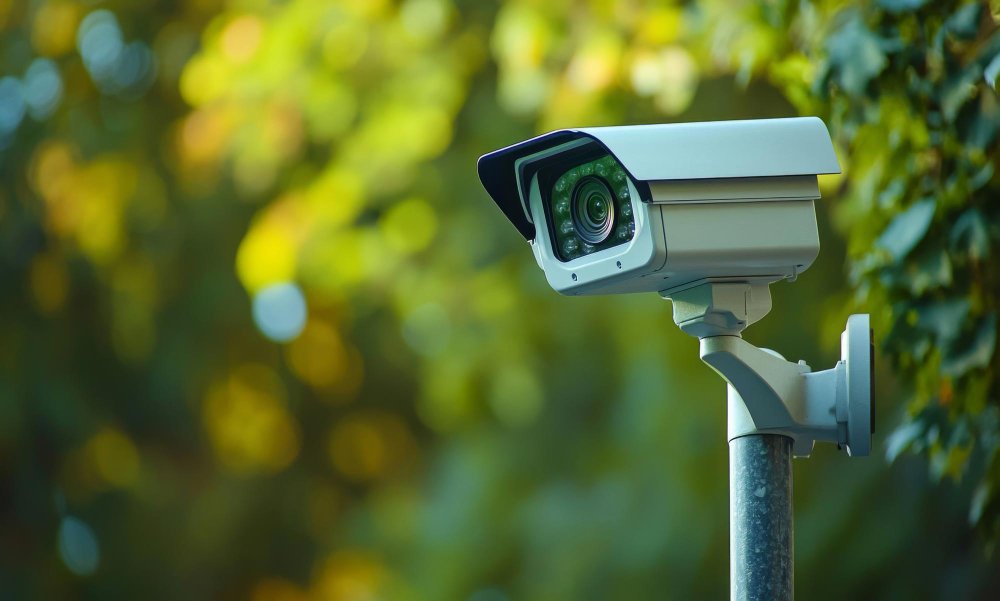
- A visible lens, usually behind a dark dome or a small round window.
- A small indicator light.
- At night, look for a faint red glow around the camera from its infrared lights.
Not spotting any of these doesn’t prove nothing is there, but they are the easiest signs to check.
Final Thoughts
Pick a camera for the level of detail you need at that spot, not for the highest figure on the box. A 100-foot range on a package means the camera can show movement at 100 feet. A face at the front gate still needs a lens and resolution selected for that job.
Once you know the DORI levels, measure the distance, determine what you need to see at that distance, and match the lens and resolution accordingly.
If you’d like help planning coverage for your home or business, please call R&N Technical or request a consultation. We provide electronics installation services in Colorado Springs and can help you get the right camera in place.
Frequently Asked Questions
Q1. How far can a security camera see at night?
Most cameras have infrared night vision that reaches 30 to 100 feet. However, seeing movement is easier than identifying a face. You may need extra lighting or a closer camera for clear details.
Q2. How far can outdoor security cameras see?
It depends on the lens. Wide-angle cameras cover around 20 to 50 feet, while zoom and varifocal cameras can see farther. However, clear facial details are only possible at shorter distances.
Q3. Does a higher-resolution camera see farther?
Yes. At the same lens angle, a 4K camera can capture more detail at greater distances than a 1080p camera. However, it also needs more storage and network bandwidth.
Q4. How far can a PTZ camera see?
A PTZ camera can monitor 100 to 200 feet or more when zoomed in. However, it only covers the direction it is facing, so it may miss activity outside its view.
Q5. How do I choose a camera for the distance I need?
Measure how far the camera will be from the area you want to monitor. Then choose a lens and resolution that can capture the level of detail you need, whether it’s a face at the front door or movement in the yard.