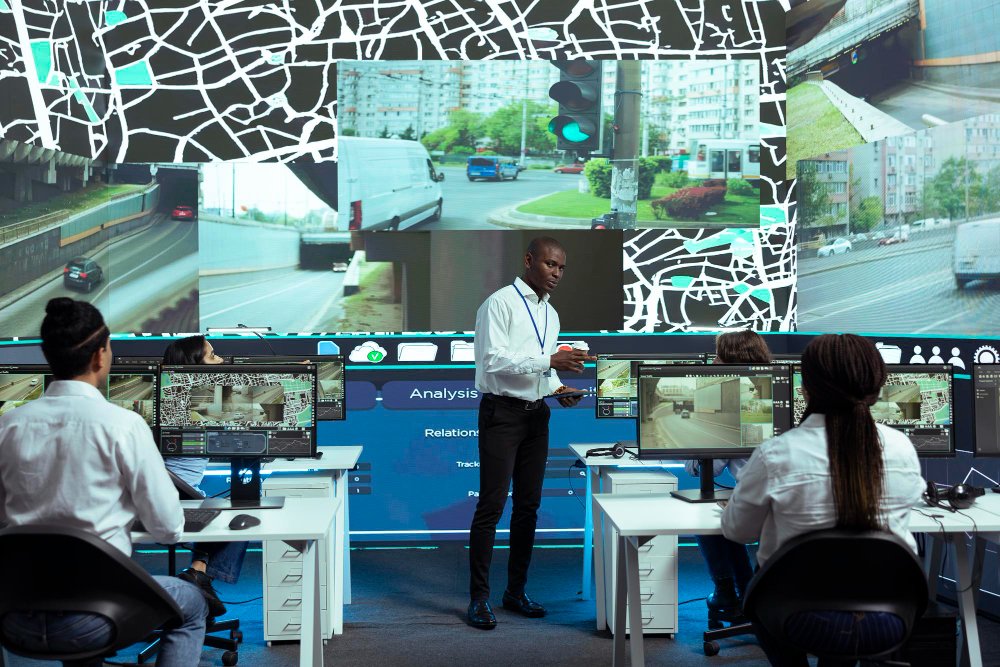
CCTV cameras come in different designs, connection types, and feature options. Each suits specific monitoring needs, from keeping an eye on your front door to covering a large parking area.
- By design: Dome, bullet, PTZ, turret, and fisheye cameras.
- By connectivity: Wired, wireless, and IP/network cameras.
- By environment: Indoor and outdoor cameras.
- By special features: Day/night, infrared, thermal, varifocal, and license plate recognition (LPR) cameras.
- By monitoring purpose: Hidden cameras and audio-enabled cameras.
This guide explains the different types of security cameras, what each is designed to do, and how to choose the right combination for your property.
CCTV Camera Types by Form Factor
A camera’s form factor refers to its physical design. This affects where you can mount it, how easily people notice it, and how much area it can cover. Among the most common types of security cameras are dome, bullet, PTZ, and turret models.
Dome Cameras
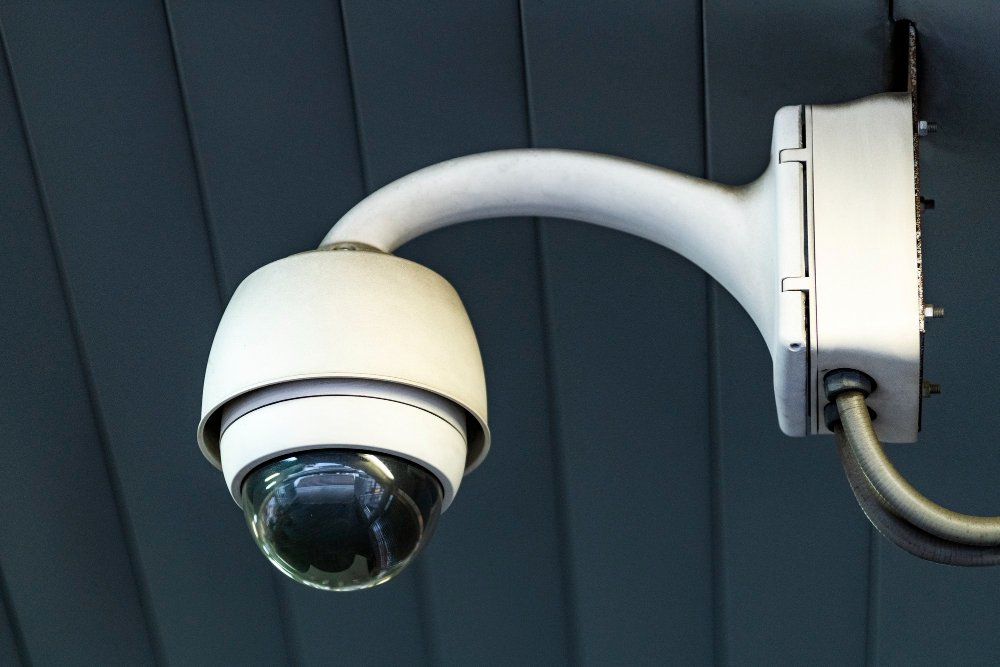
Dome cameras have a rounded cover and are commonly mounted on ceilings. Their design makes them a popular choice for indoor spaces and entrances. The dome can also make it harder to tell which direction the lens is pointing, although it does not guarantee that the camera’s viewing direction is concealed.
Pros:
- Neat appearance for indoor installations.
- Suitable for monitoring entrances, counters, and shared spaces.
- Some models offer impact-resistant housings.
Cons:
- The cover can collect dust or develop glare if poorly positioned.
- Certain dome designs are less convenient to adjust after installation.
Dome cameras are a practical option when you want consistent coverage without making the camera the main focus of the room.
Bullet Cameras
Bullet cameras have a long, cylindrical shape that makes them easy to spot. They are commonly used outside buildings to monitor driveways, parking areas, gates, loading zones, and property boundaries. Depending on the lens, a bullet camera can be configured to focus on a particular area or capture a wider view.
Pros:
- Visible design can discourage unwanted activity.
- Useful for monitoring entrances and outdoor approaches.
- Some models include infrared night vision and weather-resistant housings.
Cons:
- Their direction is usually obvious, so someone can identify the area being watched.
- Incorrect positioning often leaves gaps around corners or close to the building.
Bullet cameras work well when you need to monitor a specific outdoor area. The mounting height and viewing angle matter just as much as the camera itself.
PTZ (Pan-Tilt-Zoom) Cameras
PTZ cameras can pan from side to side, tilt up and down, and zoom in on selected areas. An operator can adjust the view remotely instead of relying on one fixed angle. This makes them useful for large parking lots, commercial yards, warehouses, and other open spaces where active monitoring is possible.
Pros:
- One camera can monitor different directions.
- Optical zoom can help operators examine distant activity.
- Preset positions and automated patrols are available on supported models.
Cons:
- A PTZ camera cannot watch every direction at once.
- Important activity may go unnoticed when the lens points elsewhere.
- These systems may cost more and require more planning.
For continuous coverage, a PTZ camera will probably need to work alongside fixed cameras that keep important entrances and pathways in view.
Turret Cameras
Turret cameras have a ball-shaped camera assembly attached to a base. Unlike many dome cameras, they do not have a clear outer dome over the lens. This can reduce certain reflections from infrared lighting, making turret designs useful for nighttime monitoring.
Pros:
- Flexible adjustment during installation.
- Suitable for indoor and outdoor applications when properly rated.
- Often a good choice for monitoring entrances, garages, and building exteriors.
Cons:
- The exposed lens assembly may be easier to interfere with physically.
- Outdoor use requires an appropriate weather-resistant rating.
Turret cameras offer a useful balance between compact design and easy positioning. You can consider this when you need reliable coverage without a bulky camera housing.
Fisheye and Panoramic Cameras
Fisheye cameras use an ultra-wide-angle lens to capture a large area, sometimes approaching 180 or 360 degrees depending on the model and mounting arrangement. They are useful in open-plan offices, retail floors, warehouses, and other areas where multiple viewing angles would require several cameras.
Pros:
- Broad coverage from one mounting point.
- Can reduce the number of cameras needed in some layouts.
- Useful for monitoring shared spaces and large rooms.
Cons:
- Images near the edges can appear curved or distorted.
- People and objects may look small when the full view is displayed.
- Digital dewarping or a closer camera view may be needed to identify details.
CCTV Camera Types by Connectivity
Some cameras use dedicated video cables, while others send footage through a computer network or wireless network. Wired, wireless, and IP cameras are also important types of security cameras to compare when planning a new system.
Wired CCTV Cameras
Wired cameras use physical cables to carry video, data, or power, depending on the system. Traditional analog cameras connect to a DVR through coaxial cable, while many IP cameras use Ethernet cables. Power can travel separately or through the same cable when the equipment supports Power over Ethernet (PoE).
Pros:
- Stable connections with less dependence on Wi-Fi.
- Suitable for permanent installations and multiple-camera systems.
- Ethernet-based PoE systems can carry data and power over one cable.
Cons:
- Cable routes need to be planned carefully.
- Installation can be more involved in finished homes or buildings.
- Adding cameras later may require additional cabling and network capacity.
Wireless CCTV Cameras
Wireless CCTV cameras send video over Wi-Fi rather than a dedicated video cable. Many still need a power cable, although battery-powered models are also available. They can be convenient for homes, small offices, or locations where running new cables would be difficult.
Pros:
- Flexible placement within reliable wireless coverage.
- Less video cabling to route through walls.
- Often convenient for smaller installations.
Cons:
- Weak Wi-Fi can cause delayed, interrupted, or missing footage.
- Walls, distance, and network congestion can affect performance.
- Battery-powered models need recharging or battery replacement.
Before choosing this type, check the camera’s power requirements, wireless signal strength, recording options, and whether it can continue recording if the internet connection fails.
IP and Network Cameras
IP cameras capture digital video and transmit it over a network. They are widely used in homes and businesses because they can integrate with network video recorders, compatible software, and remote viewing systems.
A video surveillance system for business should account for network capacity, recording storage, camera compatibility, and the number of locations being monitored.
Pros:
- Digital video with a range of resolution and feature options.
- Can support remote viewing and multiple-camera management.
- Easier to expand when the network and recording system have sufficient capacity.
Cons:
- Video traffic uses network bandwidth.
- Poor network design can affect camera performance.
- Compatibility, storage, and security settings need attention.
CCTV Camera Types by Environment
A camera designed for indoor use may not withstand rain, dust, or changing temperatures outdoors. Choose a camera based on where it will be installed and what you need to monitor.
Indoor CCTV Cameras
Indoor CCTV cameras are used in living rooms, hallways, offices, shops, and reception areas. They can include features such as motion detection, two-way audio, and low-light recording.
Pros:
- Suitable for monitoring indoor activity and entrances.
- Compact designs can blend into the room.
- Some models offer two-way audio and smart alerts.
Cons:
- Usually not designed to withstand outdoor weather.
- Furniture, doors, and bright windows can block or affect the view.
- Indoor cameras may raise privacy concerns in shared spaces.
Outdoor CCTV Cameras
Outdoor CCTV cameras are designed to withstand conditions such as rain and dust when their weather-resistance ratings allow it. They are commonly used to monitor driveways, gates, gardens, and building entrances.
Pros:
- Suitable for monitoring outdoor access points.
- Many models include infrared night vision.
- Weather-resistant and vandal-resistant options are available.
Cons:
- Not every model can withstand extreme weather.
- Poor placement can leave blind spots.
- Some locations can require extra protection against tampering.
CCTV Camera Types by Special Feature
Some cameras have features designed for specific tasks, such as recording in darkness, capturing vehicle plates, or allowing two-way communication.
Day/Night Cameras
Day/night cameras adjust to changing light conditions to capture usable footage during the day and at night. Depending on the model, they may switch from colour to black-and-white recording in low light.
Pros:
- Adapt to changing light conditions.
- Suitable for entrances, offices, shops, and outdoor areas.
- Some models provide useful footage in low light.
Cons:
- A day/night feature does not guarantee clear footage in complete darkness.
- Image quality depends on available light and the camera’s capabilities.
Infrared (IR) and Night Vision Cameras
Infrared cameras use infrared light to record footage in dark areas. The footage is often black and white, even when the area has little or no visible light.
Pros:
- Useful for monitoring driveways, garages, and building perimeters at night.
- Can record in areas with little visible light.
- Helps monitor spaces after normal lighting is switched off.
Cons:
- Night footage is often black and white.
- Nearby walls, glass, or reflective surfaces can cause glare.
- The effective night vision range varies by model.
Thermal Imaging Cameras
Thermal cameras detect heat instead of relying on visible light. They can help detect people, animals, or unusually warm equipment in dark areas.
Pros:
- Useful for detecting movement in complete darkness.
- Can support perimeter security and industrial monitoring.
- Do not depend on visible light to detect heat differences.
Cons:
- Usually cannot show clear facial details or clothing colours.
- Cannot normally read vehicle number plates.
- Often cost more than standard security cameras.
Varifocal Cameras
Varifocal cameras have adjustable lenses that let installers change how wide or narrow the camera’s view is. They are useful when the viewing angle needs to be set carefully.
Pros:
- Allow the viewing area to be adjusted.
- Useful for entrances, corridors, and loading areas.
- Can help capture more detail in a specific area.
Cons:
- May cost more than fixed-lens cameras.
- Some models require manual adjustment during installation.
- A narrower view covers less of the surrounding area.
LPR/ANPR Cameras
License plate recognition (LPR), also called automatic number plate recognition (ANPR), cameras are designed to capture vehicle registration plates at entrances, parking areas, and gates.
Pros:
- Help record vehicle registration numbers.
- Useful for parking facilities and controlled entrances.
- Can work with compatible access-control systems.
Cons:
- Require careful positioning and suitable lighting.
- Fast-moving vehicles can be difficult to capture clearly.
- Standard security cameras may not capture readable plates reliably.
Hidden and Covert Cameras
Hidden cameras are designed to be less noticeable or disguised within an object. Their use should be limited to lawful, appropriate monitoring needs.
Pros:
- Can monitor a specific area without drawing attention.
- May be useful for certain legitimate security investigations.
Cons:
- Do not provide the visible deterrent of standard security cameras.
- Recording people without proper permission can violate privacy laws.
- Audio and video recording rules vary by location.
Always check local laws before installing hidden cameras, particularly in workplaces or shared properties. Never place them in private areas such as bathrooms or changing rooms.
Audio-Enabled Cameras
Audio-enabled cameras can record sound, allow users to speak to visitors, or provide both features. Two-way audio is particularly useful for communicating with someone at an entrance.
Pros:
- Allows remote communication with visitors when two-way audio is available.
- Can provide additional context about an incident.
- Useful for certain entrances and remote locations.
Cons:
- Not every audio-enabled camera supports two-way communication.
- Audio recording raises additional privacy and legal concerns.
- Microphone and speaker quality varies by model.
Before enabling audio recording, check local laws and any consent requirements that apply to your property.
DVR vs. NVR: Which Recording System Do You Need?
CCTV cameras capture video, but a recorder stores the footage so you can watch live activity or review past events. The recording system determines how CCTV and surveillance camera footage is processed, stored, and accessed. The two main options are a DVR (Digital Video Recorder) and an NVR (Network Video Recorder).
What Is a DVR?
A DVR works with analogue cameras that usually connect through coaxial cables. It converts their video signals into digital footage and saves the recordings to a hard drive. It can be a practical, affordable choice if your property already has compatible cameras and wiring.
What Is an NVR?
An NVR works with IP cameras, which process video digitally before sending it over a network. With compatible PoE cameras, one Ethernet cable carries both power and video data, making installation simpler.
Which One Should You Choose?
A DVR suits existing analogue systems, while an NVR is generally better for new installations that need clearer footage, smart features, remote access, or room to add more cameras later.
How to Choose the Right CCTV Camera for Each Area
Follow these steps to choose a CCTV camera that suits your home or business:
- List the areas to monitor: Identify entrances, driveways, hallways, parking lots, and storage rooms.
- Set your security goal: Decide whether you need to deter intruders, monitor movement, identify people, or record vehicle number plates.
- Check the distance: Choose a camera that can clearly cover the required area, whether it is a small room or a long driveway.
- Assess the lighting: Consider daylight, low-light conditions, and complete darkness to determine whether night vision is needed.
- Choose the camera type: Select a dome, bullet, turret, PTZ, or specialist camera based on the area and level of detail required.
- Plan the position: Choose a suitable height and angle to avoid blind spots.
- Select power and storage: Decide between wired or wireless connections and local or cloud recording.
- Check privacy and future needs: Protect private areas, secure camera access, and plan for additional cameras if needed.
Final Thought
Choosing between different kinds of CCTV cameras starts with identifying the area, lighting conditions, and activity you need to monitor.
If you need help selecting and positioning the right system for your home or business, R&N Technical can help you plan your security camera system and arrange professional surveillance camera installation based on your property’s monitoring needs. They can also help with home theater system setup, improving your home network, or adding smart-home devices.
You May Also Like
Frequently Asked Questions
Q1. What are the 4 main types of CCTV cameras?
The main types of security cameras include dome, bullet, turret, PTZ, fisheye, and specialised cameras for low-light or license plate monitoring.
Q2. What are the 9 types of CCTV cameras?
Nine commonly discussed types include dome, bullet, PTZ, turret, fisheye, wired, wireless, IP/network, and infrared cameras. These categories overlap because some describe a camera’s design, while others describe its connection or features.
Q3. Is a DVR or NVR better for CCTV?
A DVR is generally suited to compatible analog cameras, while an NVR works with IP cameras. The right choice depends on your existing equipment, cabling, recording needs, and plans for future expansion.
Q4. Which type of CCTV camera is best for home use?
Wireless indoor cameras, video doorbells, and wired outdoor turret or bullet cameras are common choices for homes. Select cameras based on the areas you need to monitor, available Wi-Fi or cabling, and recording requirements.