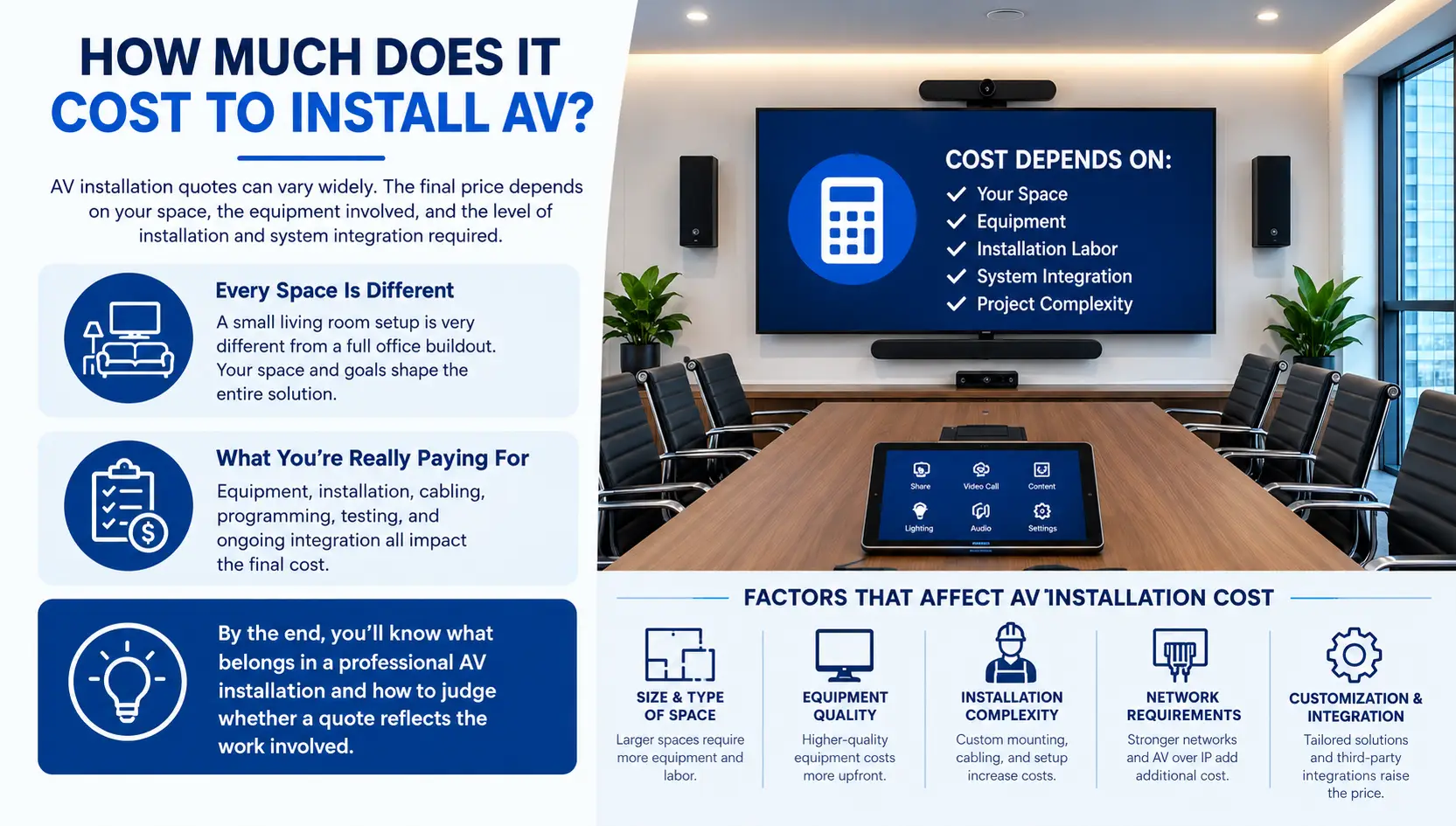
If you’ve received AV installation quotes that seem wildly different, you’re not alone.
The final price depends on your space, the equipment involved, and how much installation and system integration the project calls for. A quote for a small living room setup will look nothing like a quote for a full office buildout, and that’s expected.
This guide breaks down what you can realistically expect to pay, what drives installation costs, and which factors make one quote different from another.
By the end, you’ll know what belongs in a professional AV installation and how to judge whether a quote reflects the work involved.
How Much Does AV Installation Really Cost?
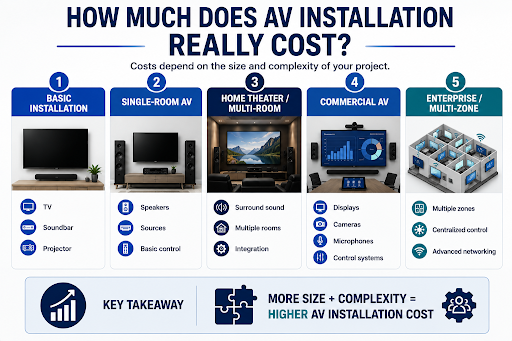
Rather than focusing on AV price, it’s more useful to compare projects of similar size and complexity. The fastest way to estimate how much the total AV cost is to identify the type of project you’re planning.
Read Also:
The Ultimate Home Theater Setup Guide for 2026
Typical Cost Ranges by Project Type
A single price doesn’t tell the whole story because installing a TV in one room is very different from designing a connected AV system for an office or an entire home.
A useful way to think about project costs is:
- Basic installation: Usually the simplest option, such as mounting a TV, connecting a soundbar, or setting up a projector.
- Single-room AV: Adds dedicated speakers, multiple sources, or basic control for one room.
- Home theater or multi-room: Involves more equipment, surround sound, multiple rooms, hidden wiring, and system integration.
- Commercial AV: Often includes conference rooms, multiple displays, microphones, speakers, cameras, and control systems.
- Enterprise or multi-zone: The most complex category, with several rooms or zones, centralized control, advanced networking, and extensive integration.
The important point is that AV costs generally rise with the size and complexity of the system.
You’re not just paying for more equipment. Larger projects require more planning, wiring, configuration, testing, and coordination to make everything work together reliably.
AV Labor and Engineering Rates
If you already own your audio and visual equipment, you may only need professional installation rather than a complete system package. In that case, labor is usually charged by the hour, and the final cost depends on the complexity of the work.
For budgeting purposes, think of professional AV work this way:
- Basic installation: A straightforward TV, soundbar, or projector setup may take a few hours. Labor stays on the lower end because the work mainly involves mounting, connecting, and testing.
- System design and installation: A larger setup can take a full working day or longer. The added planning, cable runs, speaker installation, and equipment configuration increase the labor cost.
- Complex integration: Multi-room AV, concealed wiring, networking, or camera integration can take several days. More technician hours mean a larger installation investment.
- Custom programming: Advanced control systems require additional hours for programming, testing, and adjustments. This is usually added on top of the installation work.
The total labor cost depends on how long the installation takes, which is influenced by cable routing, existing infrastructure, system complexity, and the amount of testing or programming required.
Standard AV systems that use USB conferencing devices or basic remotes are generally faster and less expensive to install.
On the other hand, custom platforms such as Crestron, Extron, Q-SYS, and Loxone are control systems that let users manage multiple devices, such as displays, audio, lighting, and other technology, from one interface.
They require additional implementation to make everything work together, which adds to the labor time and installation cost.
What Does AV Equipment Actually Cost?
Equipment is only one part of an AV installation quote, but understanding the hardware costs makes it easier to evaluate where your money is going.
Every category has entry-level and premium options, so two systems that look similar can have very different equipment costs.
There is no fixed percentage for every AV system, but as a general budgeting guide, the main equipment can account for roughly half to two-thirds of the overall project cost. The rest may go toward installation, wiring, design, configuration, programming, and testing.
Within the equipment budget, the biggest share usually goes toward the components that define the system, such as the display, projector, speakers, or control hardware.
Smaller items like cables, adapters, and mounts take up a much smaller share, but they still need to be included in the budget.
As more devices are added, the equipment cost naturally increases, but so does the amount of installation, programming, and testing required.
For example:
- A family room may only need a TV, soundbar, and streaming device.
- A dedicated home theater often includes an AV receiver, surround sound speakers, subwoofers, a projector or large display, acoustic treatments, and a control system.
- A commercial boardroom may require multiple displays, ceiling speakers, wireless presentation systems, video conferencing hardware, digital signal processors, and enterprise-grade network equipment.
You May Also Like:
How Much Does It Cost to Install a Security Camera?
Choosing the Right Equipment Tier
The most expensive equipment isn’t always the best investment.
Choosing equipment based on how the space will actually be used often delivers better performance and better value than simply buying premium products across the board.
Keep in mind: Expensive equipment doesn’t automatically lead to a much higher installation quote. In most projects, the biggest differences come from the labor required to install, wire, program, and integrate the equipment into a reliable AV system.
Why Is AV So Expensive?
Every space also has different acoustics, layouts, and technology requirements, so most AV systems need to be customized rather than installed using a one-size-fits-all approach.
It is expensive because you are paying for more than just the equipment. The total cost includes specialized hardware, professional system design, skilled installation, wiring, programming, testing, and calibration.
Understanding Local AV Installation Pricing
A local AV professional can evaluate your space, identify any wiring or network upgrades that may be needed, and provide a quote based on the actual scope of work rather than a broad national average.
Your actual project cost may vary depending on your property’s layout, the complexity of the installation, local labor rates, and applicable building requirements.
If you’re comparing electronics installation services in Colorado Springs, it’s worth requesting a site-specific estimate instead of relying on general online pricing.
This helps you budget more accurately and avoid unexpected costs once the installation begins.
What Actually Drives AV Installation Pricing Up or Down
The final price isn’t based on one factor. It’s influenced by the amount of labor involved, the condition of your existing infrastructure, how the system will be integrated, and the time needed to complete the installation.
Where the Money Actually Goes
Most AV installation costs go toward skilled labor, not just the equipment. While displays, speakers, and other hardware are part of the budget, a significant portion of the total cost covers planning the system, running and concealing cables, mounting equipment, configuring devices, testing performance, and making sure everything works together as intended.
Why Cable Length Isn’t the Cost Driver You Think It Is
In most cases, the cable itself is relatively inexpensive. The real cost comes from the work required to install it.
For example, running a cable through an unfinished basement may take only a short time. Running that same cable through finished walls, ceilings, or above a fireplace requires more planning, specialized tools, and careful workmanship.
That’s why installation time usually has a much bigger impact on cost than the length of the cable itself.
The Hidden Cost Most People Forget
The hidden cost is upgrading your network. Many AV systems need a fast, reliable wired or wireless network to perform properly. You may need new Ethernet cabling, network switches, access points, or other upgrades before the AV installation can begin.
Adding network installation services to the project increases the upfront cost, but it helps prevent connection issues, improves system performance, and supports future technology upgrades.
Larger home theaters and commercial spaces often need speaker calibration, acoustic adjustments, and advanced audio formats such as Dolby Atmos to deliver clear, balanced sound. These extra services require specialized tools and expertise, adding to the overall cost.
Existing Infrastructure and Integration Matter
Running cables behind finished drywall, concrete, or brick walls takes much more time than using existing conduit or surface raceways.
If walls need to be opened or new wiring paths created, labor costs increase quickly. Homes and buildings with pre-installed wiring are usually less expensive to work on.
Integration also affects pricing. Connecting one TV is quick, but linking displays, speakers, security cameras, lighting, and smart controls into one system takes more installation, programming, and testing, increasing the overall cost.
Also Read:
Pros and Cons of Video Surveillance
Security and Surveillance Add-Ons: Garage Cameras and Video Surveillance Costs
Many homeowners and businesses also integrate security cameras so they can monitor their property from the same network or control platform.
Since the AV system installer is already running cables, configuring the network, and setting up connected devices, adding surveillance equipment usually requires less additional labor than scheduling a separate installation.
Garage and Driveway Camera Installation Costs
A single garage camera installation is a popular upgrade for homeowners who want to monitor vehicles, deliveries, or entry points.
The total cost depends on the camera type, mounting location, wiring requirements, and whether an existing network connection can be used.
Multi-Camera Video Surveillance System Pricing
A video surveillance installation covering multiple areas of a home or business requires more planning, wiring, and configuration than a single-camera setup.
If the property already has a reliable wired network or structured cabling, installation is usually faster and less expensive.
Planning Your AV Installation Budget
Planning an AV installation doesn’t have to be complicated.
Once you understand what affects the cost, from wiring and network readiness to system integration, it’s easier to evaluate quotes and choose a solution that fits your space and goals.
If you’re comparing options, look beyond the final price and make sure you understand what’s included.
At R&N Technical, we believe a well-planned AV system starts with clear advice, quality workmanship, and a solution that’s built to perform reliably today and adapt to your needs in the future.
Frequently Asked Questions
Q1. How much does a basic home AV installation cost?
Pricing for AV installations usually starts in the low thousands for basic setups, climbing into the tens of thousands for larger multi-room systems depending on scope.
Q2. Does upgrading to 4K significantly increase installation cost?
Not much. The jump from 1080p to 4K has minimal impact on labor, since the wiring and setup work stay the same.
Q3. Is DIY installation actually cheaper than hiring a professional?
Sometimes upfront, but calibration or wiring mistakes often cost more to fix later than a proper AV system service would have.
Q4. Do I need to upgrade my network for a new AV system?
Often yes, especially for streaming or multi-room setups, since a weak network can undercut even well-installed equipment.
Q5. What’s typically included in a professional AV installation quote?
Labor, equipment, and any needed network upgrades; an AV system service should break these out separately in a transparent quote.