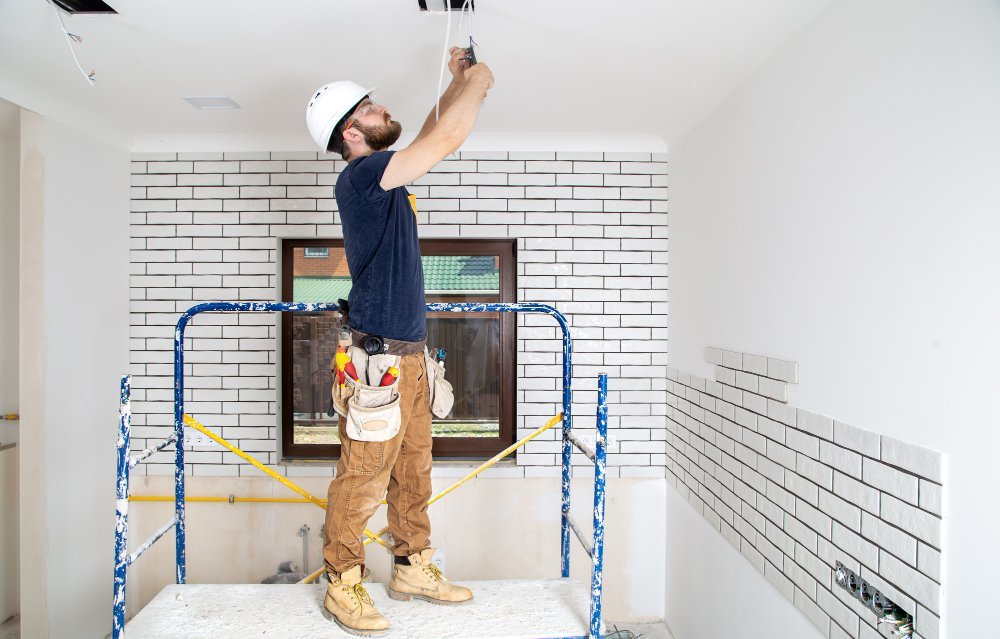
Yes, a house can be rewired without removing drywall. Electricians do this by fishing wires through wall cavities, running new cable through the attic or crawlspace, and cutting only small, patchable access holes where needed.
Throughout the project, your walls stay fully intact. The electrician will only cut 10 to 30 small, palm-sized holes across the entire house. These are small, strategic access points near the ceiling or floor to help feed the wires through the framing.
Once the wiring is done, a drywaller can easily patch and paint these small squares. Within a few days, your walls will look completely untouched.
In this guide, we’ll explain the signs that indicate a home may need rewiring, how electricians replace wiring with minimal drywall damage, and why a rewiring project can also be a good opportunity to plan future technology upgrades.
Signs Your Home May Need Rewiring
Rewiring your home usually becomes necessary when the existing electrical system can no longer safely handle modern electrical demands. Modern households run multiple heavy appliances simultaneously. Older electrical systems simply weren’t designed for this load.
Electrical problems often start as small annoyances. Over time, they can become signs that the wiring behind the walls is reaching the end of its useful life.
Here are the clear warning signs that your current system is struggling:
1. Frequent Breaker Trips
A breaker that trips occasionally is not unusual.
If certain circuits trip regularly when using appliances, space heaters, or entertainment equipment, the wiring may be overloaded.
2. Flickering or Dimming Lights
Lights that flicker when an appliance turns on can sometimes point to loose connections, overloaded circuits, or aging wiring.
This doesn’t always mean the entire house needs rewiring, but it is often worth having the system inspected, especially in older homes.
3. Warm Outlets or Burning Smells
Outlets and switches should never feel hot to the touch.
A faint burning smell, discoloration around outlets, or melted faceplates can indicate that connections are deteriorating or generating excess heat.
These issues should be inspected promptly because the cause is not always visible from the outside.
4. Ungrounded Two-Prong Outlets
Two-prong outlets are common in older homes.
While they may still function, they do not provide the same level of protection for modern electronics. This becomes increasingly important when installing networking equipment, security cameras, home theater systems, or other sensitive devices.
4. Buzzing Switches or Outlets
Electrical systems should operate quietly.
Buzzing, crackling, or humming sounds from outlets, switches, or panels may indicate loose connections or aging components.
Many homeowners simply get used to these noises over time, but they often need a closer look.
5. Extension Cords Everywhere
One of the most overlooked signs is a house that depends heavily on power strips and extension cords.
Relying on power strips and extension cords means your home lacks enough permanent outlets, which overburdens the existing circuits.
The best next step you can take is to schedule a professional electrical inspection that can identify which parts of the system need attention, whether a partial rewire is possible, and how much wall access may actually be required.
How Do Electricians Rewire Your Home Without Tearing Dry Walls?
Many homeowners researching how to rewire a house assume the project requires tearing open every wall, but that usually is not the case.
Electricians can usually run new wiring through attics, crawlspaces, and existing wall cavities, causing minimal damage to the drywall
Step 1: Inspecting the Existing Electrical System
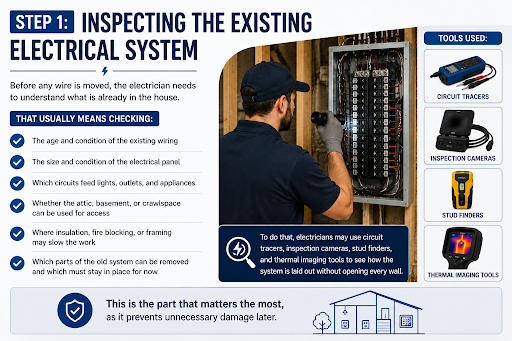
Before any wire is moved, the electrician needs to understand what is already in the house.
That usually means checking:
- The age and condition of the existing wiring
- The size and condition of the electrical panel
- Which circuits feed lights, outlets, and appliances
- Whether the attic, basement, or crawlspace can be used for access
- Where insulation, fire blocking, or framing may slow the work
- Which parts of the old system can be removed and which must stay in place for now
To do that, electricians may use circuit tracers, inspection cameras, stud finders, and thermal imaging tools to see how the system is laid out without opening every wall.
This is the part that matters the most, as it prevents unnecessary damage later.
Step 2: Mapping the New Wire Routes
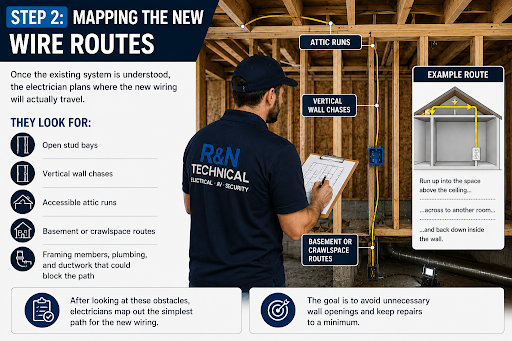
Once the existing system is understood, the electrician plans where the new wiring will actually travel.
They look for:
- Open stud bays
- Vertical wall chases
- Accessible attic runs
- Basement or crawlspace routes
- Framing members, plumbing, and ductwork that could block the path
After looking at these obstacles, electricians map out the simplest path for the new wiring.
Instead of running wires straight through walls, they try to use existing hidden spaces inside the home. For example, they may run a wire up into the space above the ceiling, across to another room, and then back down inside the wall.
The goal is to avoid unnecessary wall openings and keep repairs to a minimum.
Step 3: Using the Attic as an Access Point
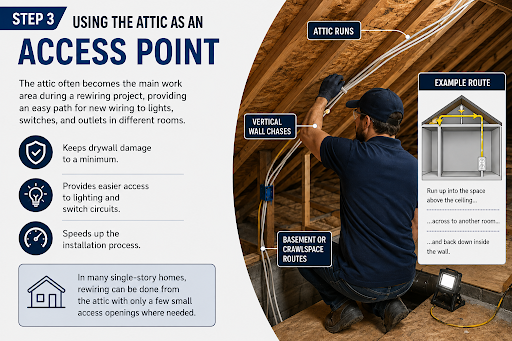
The attic, which is the open space between your ceiling and roof, often becomes the main work area during a rewiring project.
Since electricians can move through this space without opening finished walls, it provides an easier path for running new wiring to lights, switches, and outlets in different rooms.
It works well because it usually:
✔ Keeps drywall damage to a minimum.
✔ Provides easier access to lighting and switch circuits.
✔ Speeds up the installation process.
In many single-story homes, rewiring can be done from the attic with only a few small access openings where needed.
Step 4: Pulling Wires Through Finished Walls
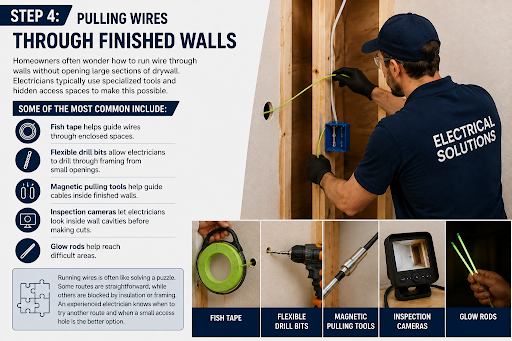
Homeowners often wonder how to run wire through walls without opening large sections of drywall. Electricians typically use specialized tools and hidden access spaces to make this possible.
Some of the most common include:
- Fish tape helps guide wires through enclosed spaces.
- Flexible drill bits allow electricians to drill through framing from small openings.
- Magnetic pulling tools help guide cables inside finished walls.
- Inspection cameras let electricians look inside wall cavities before making cuts.
- Glow rods help reach difficult areas.
Running wires is often like solving a puzzle. Some routes are straightforward, while others are blocked by insulation or framing.
An experienced electrician knows when to try another route and when a small access hole is the better option.
Step 5: Making Small Access Openings
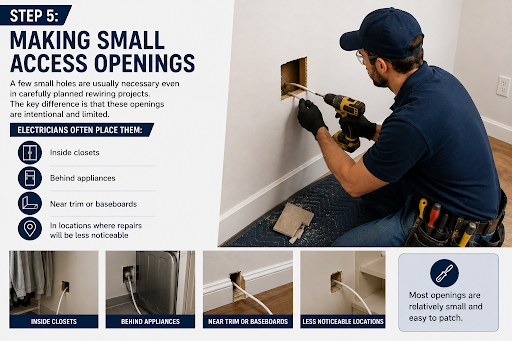
A few small holes are usually necessary even in carefully planned rewiring projects.
The key difference is that these openings are intentional and limited.
Electricians often place them:
- Inside closets
- Behind appliances
- Near trim or baseboards
- In locations where repairs will be less noticeable
Most openings are relatively small and easy to patch.
Step 6: Installing New Electrical Boxes
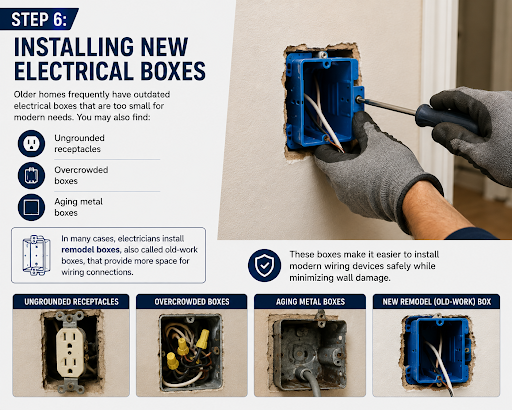
Older homes frequently have outdated electrical boxes that are too small for modern needs.
You may also find:
- Ungrounded receptacles
- Overcrowded boxes
- Aging metal boxes
In many cases, electricians install remodel boxes, also called old-work boxes, that provide more space for wiring connections.
These boxes make it easier to install modern wiring devices safely while minimizing wall damage.
Step 7: Disconnecting Old Wiring
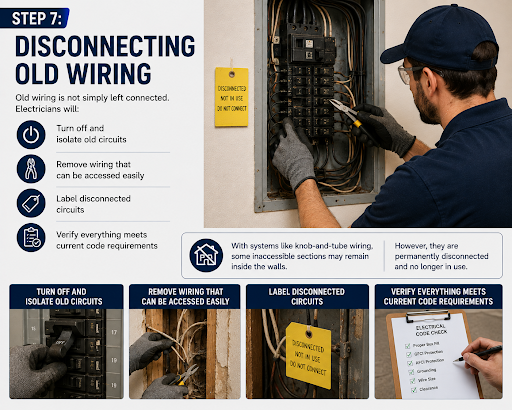
Old wiring is not simply left connected.
Electricians will:
- Turn off and isolate old circuits
- Remove wiring that can be accessed easily
- Label disconnected circuits
- Verify everything meets current code requirements
With systems like knob-and-tube wiring, some inaccessible sections may remain inside the walls.
However, they are permanently disconnected and no longer in use.
Step 8: Testing Everything Before the Job Is Finished
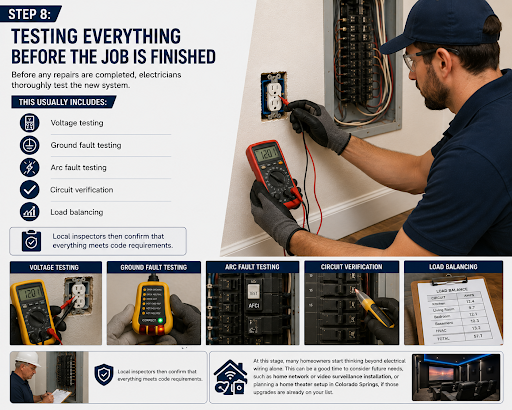
Before any repairs are completed, electricians thoroughly test the new system.
This usually includes:
- Voltage testing
- Ground fault testing
- Arc fault testing
- Circuit verification
- Load balancing
Local inspectors then confirm that everything meets code requirements.
At this stage, many homeowners start thinking beyond electrical wiring alone.
This can be a good time to consider future needs, such as home network or video surveillance installation, or planning a home theater setup in Colorado Springs, if those upgrades are already on your list.
How Long Does It Take and How Messy Is It?
A full house rewire typically takes 3 to 10 days, depending on the size of the home and how easy it is to access the existing wiring.
The project is usually less messy than many homeowners expect. Instead of major demolition, most of the mess comes from a few small access holes, minor drywall dust, and patching work afterward.
Homeowners can continue living in the house during the project, although power may be temporarily shut off in certain areas.
You May Also Like
The Ultimate Home Theater Setup Guide for 2026
While the Walls Are Open: The Smart Time to Add AV, Network & Security Wiring
If your home is already being rewired, it is often the best time to think about future technology upgrades as well.
Running extra wiring now is usually much easier and less expensive than opening walls again later. This can include cables for a home network installation, especially if you deal with Wi-Fi dead zones or want more reliable connections for streaming and home offices.
It is also a good opportunity to prepare for video surveillance installation, including security cameras, garage cameras, and smart doorbells.
If you are planning a home theater setup in Colorado Springs, this is the ideal time to run speaker wires, TV connections, and other AV cables before repairs are completed.
In many cases, homeowners use AV consulting services during renovations to make sure everything is planned properly from the start.
DIY vs. Hiring a Licensed Electrician
Can you rewire a house without removing walls? In some areas, the answer is yes. Homeowners may be allowed to do their own electrical work if they obtain permits and pass inspections.
However, rewiring a house is much more complicated than replacing old wires. It involves planning new circuits, checking the electrical panel, meeting current code requirements, and making sure everything is properly grounded.
It can also be difficult to run wires through finished walls without damaging plumbing, ductwork, or drywall.
Mistakes can lead to failed inspections, insurance issues, or expensive repairs later.
A full house rewire is different. In most cases, hiring a licensed electrician is the recommended approach because it helps ensure the work is safe, code-compliant, and completed with as little damage to the home as possible.
While Your Walls Are Open, Plan the Rest
If an electrician is already opening up your walls for a rewire, that’s a good time to add the wiring for your network, security cameras, and home entertainment system at the same time. Running those cables now is usually simpler and less expensive than opening the walls again later.
We help homeowners to plan and install that wiring, network drops, camera runs, and AV cabling, so everything is in place and ready to go once the walls are closed back up.
Request a consultation to get started.
FAQs
Q1: Can a house be rewired without removing drywall?
Yes. In many homes, electricians can replace wiring with only a few small, patchable holes instead of removing entire walls.
Q2: How to rewire a house without removing drywall?
Electricians usually run new wires through spaces above the ceiling, below the floor, and inside wall cavities while minimizing wall openings.
Q3: How much damage does rewiring usually cause?
Most projects create minor drywall dust and a few small access holes rather than major demolition.
Q4: How long does it take to rewire a house?
A full house rewire typically takes about 3 to 10 days, depending on the size and layout of the home.
Q5: Can you stay in the house during rewiring?
Usually, yes. However, power may need to be temporarily shut off in certain areas while work is being completed.